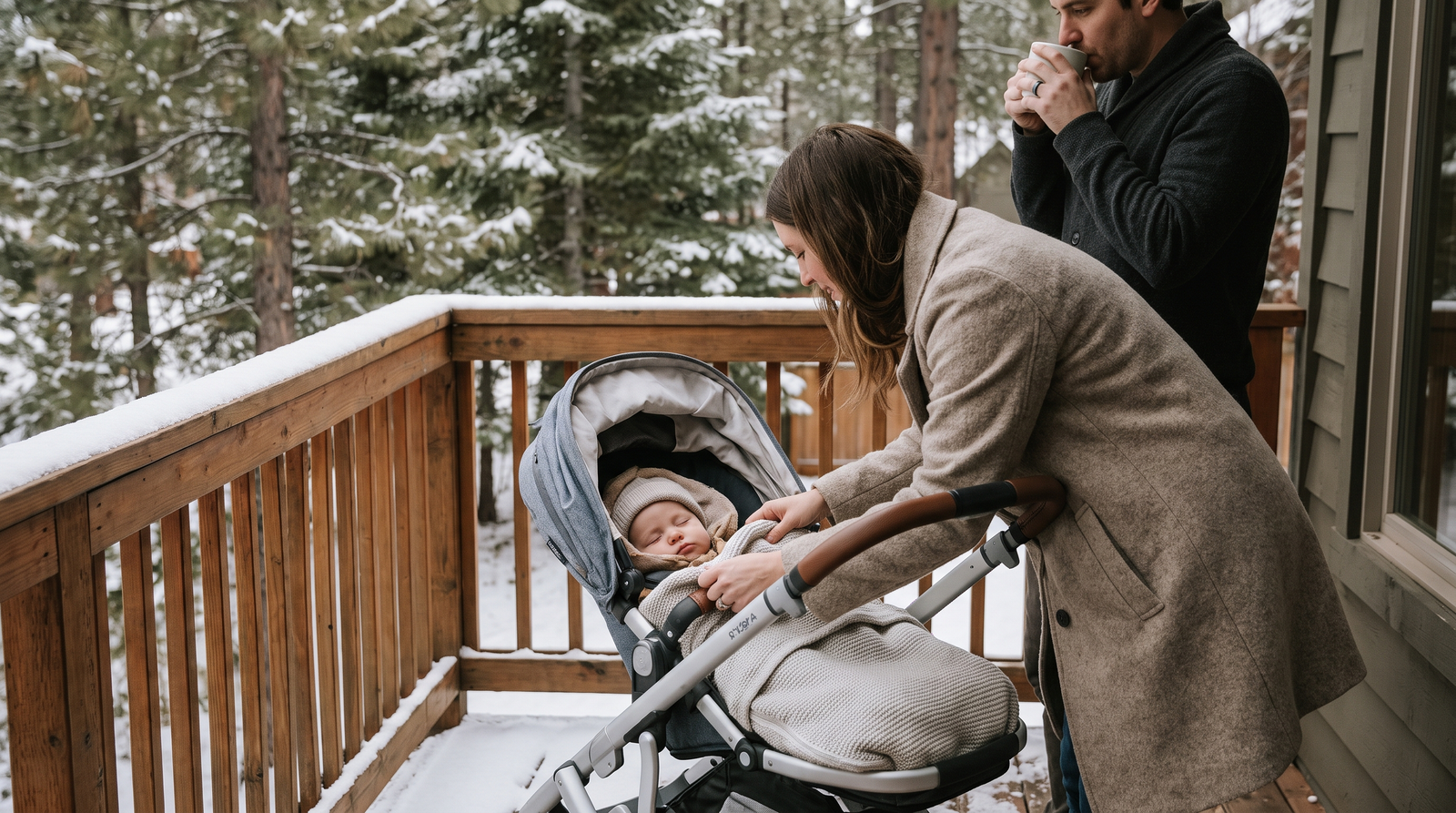
Explore the Nordic baby sleep routine outdoor-nap tradition, safe cold-weather layering, pram setup, temperature checks, and a protected rest window for exhausted mothers.
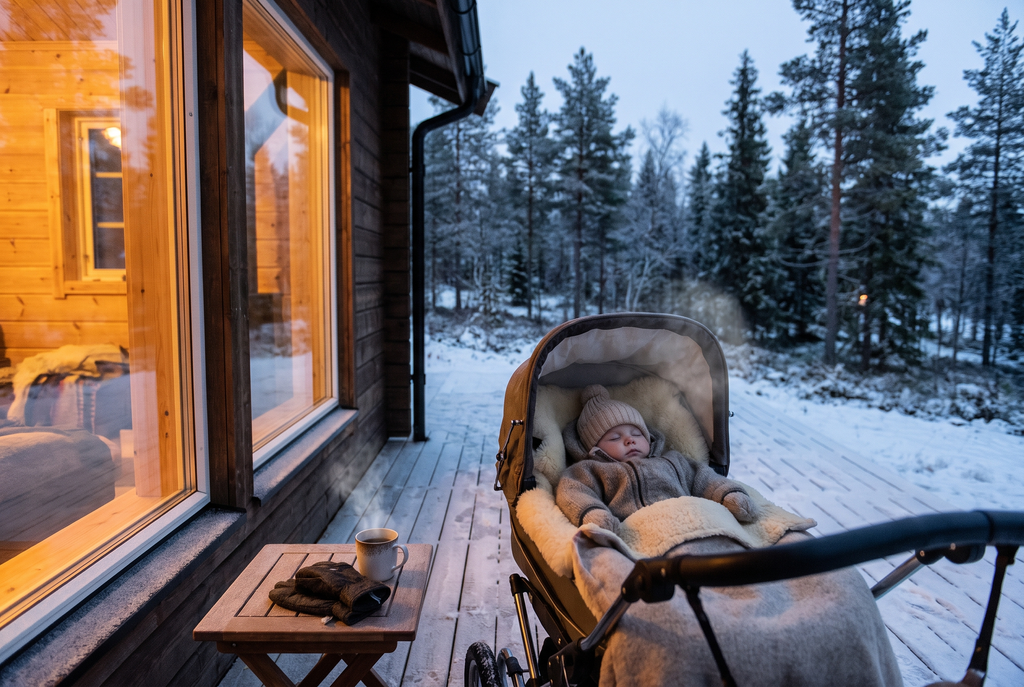
All products are personally selected by us. If you buy something, we may earn an affiliate commission.
Before you schedule another appointment, download another sleep app, or drink your fourth coffee, consider the surprisingly simple Scandinavian nap ritual: fresh air, a warm baby, and a mother.
Table of Contents
The Cold-Air Nap System (Sova Ute)
There’s a particular kind of exhaustion only a mother with a chronically short‑napping baby understands. You finally get the baby down, tiptoe away, hold your breath—and twenty‑three minutes later, the eyes pop open.
The rest of the day becomes a loop of feeding, soothing, pacing, and trying again while you run on broken sleep and caffeine. That’s why the Scandinavian tradition of outdoor baby naps, known as sova ute, is so fascinating.
In Nordic countries, babies have long napped outdoors—even in cold weather—when properly dressed and supervised. And before anything else, it’s important to clear up one big misconception; but let’s clear up one important misconception immediately:
Cold air isn’t a magic sleep drug.
There isn’t strong evidence that simply exposing an infant to colder temperatures creates deeper or longer REM sleep, and cold exposure can become dangerous if an infant becomes too cold.
The appealing part of the Nordic practice is the broader system: fresh air, predictable routines, appropriate clothing, reduced indoor stimulation, and a protected period of rest.
So let’s borrow the useful parts—and leave the risky folklore behind.
Read more: The anti-anxiety Color Palette: Scandinavian Theory for a Calmer Home
First: Safety Comes Before the Scandinavian Aesthetic
Before attempting outdoor naps, talk with your pediatrician, particularly if your baby is premature, very young, has a medical condition, or has difficulty regulating body temperature.
And never use outdoor sleeping as a reason to ignore safe-sleep guidance.
For sleep, the American Academy of Pediatrics recommends placing babies on their backs, on a firm, flat sleep surface, with no loose blankets, pillows, bumpers, stuffed toys, or other soft objects around them.
A stroller or pram is not automatically an approved sleep space simply because a baby falls asleep in it.
Follow the manufacturer’s instructions for your specific pram or bassinet and your local pediatric guidance.
If your baby is sleeping outdoors, adult supervision still matters.
This isn’t:
“Put baby outside and go watch television.”
It’s:
Create a controlled environment and remain attentive.
That’s the difference.
Why Do Scandinavian Parents Nap Babies Outside?
The appeal isn’t difficult to understand.
Fresh outdoor air can be a pleasant change from a warm, stimulating indoor environment.
Daylight provides strong environmental cues.
Outdoor sounds can be steady and less socially stimulating than household activity.
And a stroller or pram can create a predictable nap ritual.
There’s also something beautifully practical about it.
The baby sleeps.
The mother gets a pause.
The household doesn’t need to revolve around keeping the entire house silent.
That’s the part worth stealing.
Not the mythology that “cold air guarantees better sleep.”
Read more: The Scandinavian 3-Zone Decompression Entryway Design: How to Stop Home Anxiety at the Front Door
The Thermoregulation Principle
If you do use an outdoor nap routine, the objective is not to make your baby cold.
The objective is to maintain a comfortable body temperature while providing appropriate protection from the outdoor environment.
This is where layering becomes useful.
A simple principle is:
Thin base layer → insulating layer → weather protection.
For colder conditions, natural wool can be useful because it provides insulation while managing moisture.
But don’t blindly follow an “exact wool-to-fleece formula.”
There isn’t a universally safe clothing recipe for every baby, temperature, humidity, wind speed, or pram.
A newborn at 25°F and a healthy older infant at 40°F don’t have the same requirements.
Instead, use clothing appropriate to the actual conditions and your baby’s age, health, and tolerance.
A Practical Layering Blueprint
For a cold-weather outdoor nap, think in categories.
Layer One: Base
A soft, moisture-managing base layer.
Merino wool is one option.
It can provide warmth without requiring a bulky layer directly against the skin.
Avoid overheating with excessive layers.
Layer Two: Insulation
Add an insulating layer appropriate to the temperature.
This could be a wool layer or another suitable insulating garment.
Fleece can work as an insulating material, but the right choice depends on the overall system and weather.
Layer Three: Weather Protection
A weather-resistant outer layer or properly designed stroller footmuff can help protect against wind and moisture.
But remember:
A footmuff isn’t a license to add unlimited clothing underneath it.
Some insulated products can make babies too warm when combined with multiple layers.
Always follow the product’s instructions.
Forget the Hands. Check the Baby’s Core.
Here’s one piece of advice that’s particularly useful for parents:
Cold hands don’t necessarily mean a baby’s body is too cold.
Infants’ hands and feet can feel cool because peripheral circulation is different from an adult’s.
Instead, check the baby’s chest, upper back, or neck to assess whether they feel comfortably warm.
You’re looking for a comfortably warm—not sweaty or hot—core.
Signs of overheating can include sweating, flushed skin, unusually warm skin, or damp hair.
If your baby feels cold at the core, appears unusually sleepy or difficult to rouse, has pale or bluish skin, or otherwise seems unwell, bring them indoors and seek appropriate medical advice.
When in doubt, don’t gamble.
Warm and comfortable beats “Nordic enough.”
The Airflow Protocol
Fresh air doesn’t mean maximum exposure to the elements.
Your pram needs a controlled setup.
Think about four things:
Wind
Avoid positioning the pram where strong wind blows directly onto the baby’s face.
Use the pram’s manufacturer-approved weather protection rather than improvising with blankets over the opening.
Sun
Direct sunlight can heat a pram surprisingly quickly.
A cold outdoor temperature doesn’t prevent overheating in direct sun.
Keep the baby shaded appropriately and follow safe-pram guidance.
Rain and Snow
Waterproof protection matters.
A wet baby loses heat much more quickly than a dry one.
Airflow
Never cover a pram opening with a loose blanket or material that can restrict ventilation.
A breathable, manufacturer-designed canopy or weather cover is a much safer approach.
The principle is simple:
Protect from weather without sealing the baby into a poorly ventilated enclosure.
The Product I’d Actually Put on the Shopping List
If you’re building a cold-weather nap setup, I’d prioritize a properly fitted, manufacturer-approved stroller footmuff rather than trying to create a complicated DIY layering system.
One well-known option is the 7AM Enfant Blanket 212 Evolution, a stroller blanket designed for cold-weather use and adjustable as a child grows.
You can shop the 7AM Enfant Blanket 212 Evolution on Amazon.
Check the current manufacturer’s temperature guidance, compatibility with your stroller, harness requirements, and installation instructions before using it.
And remember: product temperature ratings aren’t universal guarantees.
Your baby’s clothing underneath, the wind, humidity, sunlight, age, and activity level all affect thermal comfort.
Don’t Cover the Baby’s Face
This deserves its own rule.
Never cover your baby’s face with a blanket, scarf, muslin, or other loose fabric to keep them warm.
It can interfere with airflow and create an unsafe sleep environment.
If the weather is too severe to comfortably protect the baby while maintaining safe ventilation and sleep positioning, skip the outdoor nap.
There is no prize for completing the Nordic challenge in terrible weather.
The Mother’s Sanity Block
Now we get to the part I love most.
The nap isn’t only about the baby.
It’s about what happens to the mother while the baby sleeps.
Let’s say your baby has settled into a predictable morning outdoor nap.
You have a two-hour block.
What do you usually do?
Laundry.
Dishes.
Emails.
Cleaning.
Online shopping.
Answering messages.
Planning dinner.
More laundry.
Stop.
Not today.
The Scandinavian-inspired idea here is Fika—a cultural tradition associated with taking a deliberate pause for coffee, conversation, and something to eat.
You don’t need to replicate Swedish culture perfectly to borrow the underlying idea:
A break is allowed to be a break.
Make the Nap a Protected Block
Imagine this:
Baby goes down.
You make coffee.
You put your phone on Do Not Disturb.
You sit somewhere comfortable.
You eat something.
You read.
You stare out the window.
You do absolutely nothing.
That isn’t laziness.
That’s recovery.
Mothers are often expected to turn every quiet moment into a productivity window.
The baby sleeps?
Clean.
The baby naps again?
Answer emails.
Someone gives you an hour?
Catch up on laundry.
No wonder we’re exhausted.
A protected nap window can become a tiny psychological boundary.
Baby sleeps. Mother resets.
What Should You Do During the Two Hours?
Whatever genuinely restores you.
Try creating a short menu:
20 minutes: Coffee and breakfast.
30 minutes: Reading.
20 minutes: Shower.
30 minutes: Nap yourself if you can.
20 minutes: Do nothing.
Notice what’s missing?
Housework.
You can do it later.
Or tomorrow.
Or when the laundry develops legs and starts paying rent.
Your nervous system deserves consideration too.
The Routine Matters More Than the Temperature
Here’s perhaps the most important lesson.
Don’t obsess over reproducing some mythical Scandinavian temperature.
Instead, build a consistent sequence.
Wake.
Feed.
Dress.
Go outside.
Settle into the approved sleep space.
Monitor.
Rest.
Return inside.
Repeat when appropriate.
Predictability can help babies understand the rhythm of their day.
And it gives mothers something even more valuable:
a plan.
When you’re sleep-deprived, uncertainty is exhausting.
A repeatable routine removes some of it.
What If the Baby Only Sleeps for 30 Minutes?
Then you have a 30-minute nap.
Don’t turn the system into another source of pressure.
Infant sleep varies enormously.
Developmental changes, feeding needs, illness, teething, growth spurts, and temperament can all affect naps.
The goal isn’t to manufacture a two-hour sleeper.
The goal is to create conditions that are safe, predictable, and supportive of sleep.
If naps are consistently very short and your baby seems overtired or isn’t sleeping well overall, talk with your pediatrician.
Sometimes the answer isn’t another environmental hack.
Sometimes you need individualized guidance.
Your Sova Ute Setup
If you’re curious about trying an outdoor nap routine, start conservatively.
Before the Nap
Check the weather.
Check the wind.
Check the baby’s health.
Dress appropriately.
Make sure the sleep surface and position comply with safe-sleep guidance and the stroller/pram manufacturer’s instructions.
During the Nap
Keep the baby appropriately protected from sun, wind, rain, and cold.
Maintain ventilation.
Check the baby’s core temperature periodically.
Stay attentive.
After the Nap
Bring the baby inside if conditions change or the baby seems uncomfortable.
Don’t chase a predetermined nap duration.
The environment is there to support the baby—not the other way around.
The Weekend Experiment
You don’t need to commit to an elaborate Nordic sleep philosophy.
Try one carefully planned outdoor nap when weather conditions are appropriate.
Prepare everything beforehand.
Set up the approved sleep space.
Dress the baby appropriately.
Stay nearby.
And then—here’s the radical part—do nothing productive.
Make your coffee.
Sit down.
Read something.
Call a friend.
Close your eyes.
Breathe.
For one nap, your job isn’t to optimize the household.
It’s to recover from being the person who keeps the household running.
The Bigger Lesson
The beauty of the Scandinavian outdoor-nap tradition isn’t that cold air is some secret biological shortcut.
It’s that it challenges a familiar parenting assumption:
The baby sleeps, therefore the mother must work.
No.
The baby sleeps.
The mother can rest.
Fresh air may be part of the routine.
Appropriate clothing may help maintain comfort.
A predictable environment may support consistency.
But the real luxury is the boundary.
A protected block of time where nobody needs anything from you.
No dishes.
No laundry.
No productivity challenge.
Just coffee, quiet, and the knowledge that for the next little while, you don’t have to make the entire world function.
That is the part of sova ute worth remembering.
Not “make your baby sleep in the cold.”
Rather:
Create a safe, predictable nap ritual—and give the mother permission to rest, too.
Because a well-rested mother isn’t a selfish luxury.
She’s a human being who has been carrying an enormous amount.
And sometimes the most practical Scandinavian design principle of all is simply this:
Make room for the person doing the caring.