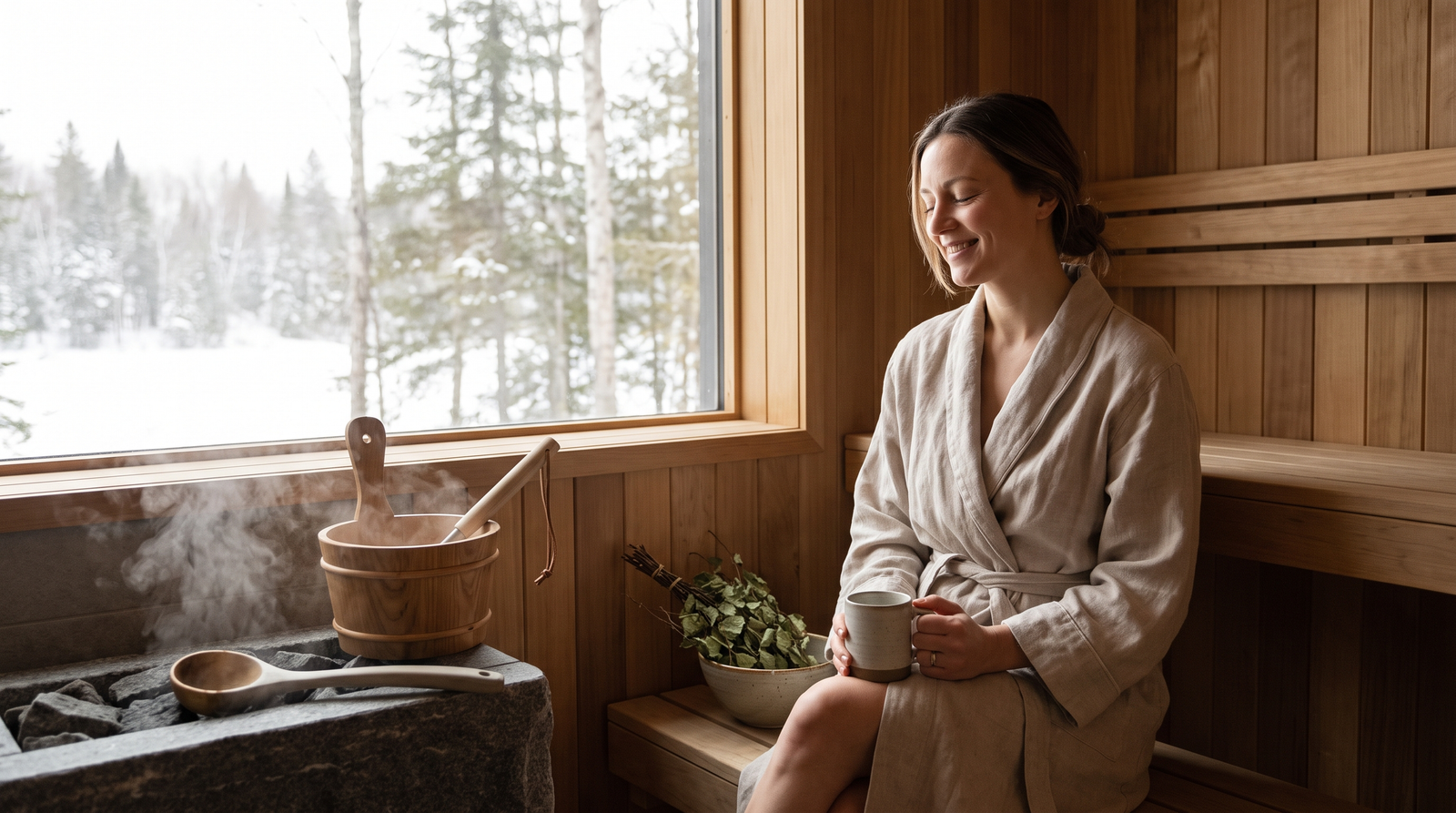
Discover a practical 15-minute Nordic-inspired heat therapy routine using warmth, gentle cooling, and an electronics-free reset to unwind at home.
All products are personally selected by us. If you buy something, we may earn an affiliate commission.
You don’t need a luxury sauna, a two-hour spa appointment, or another wellness gadget to create a daily ritual that tells your body: we’re done for today. The “Micro-Dose” Heat Therapy (Bastu Isolation)
Table of Contents
There’s a particular kind of tiredness that sleep doesn’t immediately fix.
Your shoulders are permanently somewhere near your ears.
Your jaw is clenched.
Your back feels tight after sitting all day.
Your brain keeps replaying tomorrow’s to-do list while you’re technically supposed to be relaxing.
And then someone suggests a 90-minute spa treatment.
Lovely.
But when exactly are you supposed to find 90 minutes?
Between work, children, dinner, laundry, commuting, and trying to remember why you walked into the kitchen?
That’s where the Nordic sauna tradition offers an interesting idea—not as a miracle cure, but as a ritual of deliberate thermal and mental transition.
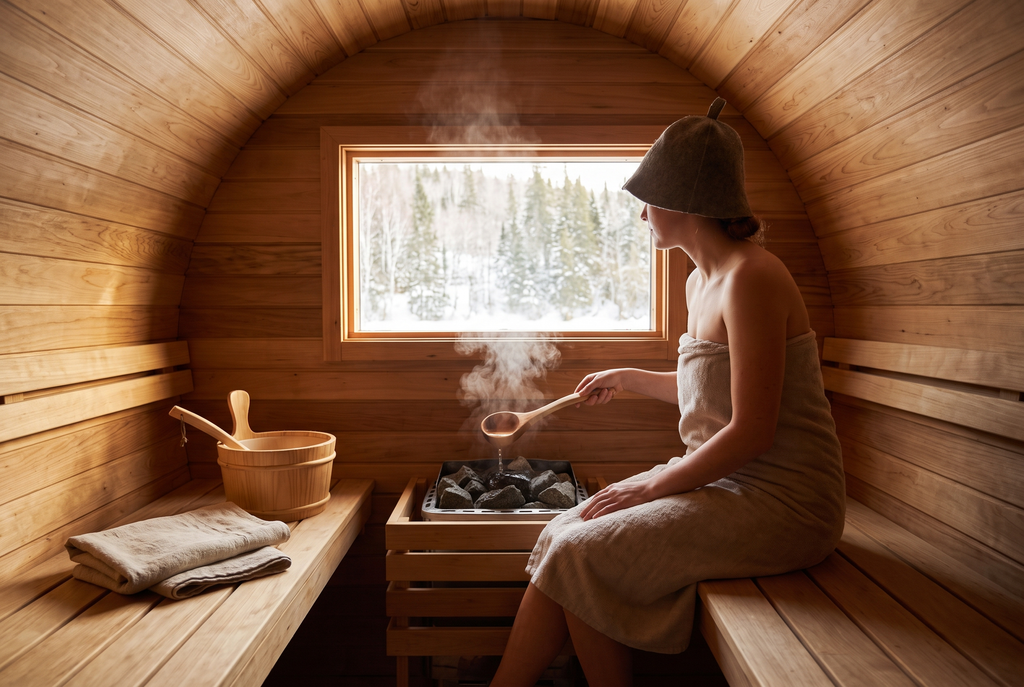
In Sweden, Finland, and across the Nordic region, sauna and heat-bathing traditions have deep cultural roots. The Swedish word bastu refers to sauna, while Finnish sauna culture is particularly well known worldwide.
The important lesson isn’t that you need to recreate a Scandinavian spa in your bathroom.
It’s that a short, repeatable ritual can create a meaningful boundary between “still working” and “I’m allowed to stop.”
And you can build a version of that ritual with ordinary household equipment.
But there’s one thing I’d change from the internet’s more extreme versions of this trend:
You don’t need to torture yourself with maximum heat followed by an ice bath.
There isn’t a magic 15-minute sequence that “flushes cortisol” from your body, and heat exposure shouldn’t be presented as a treatment for chronic inflammation or a replacement for medical care.
Instead, think of this as a 15-minute thermal reset designed around comfort, relaxation, and a simple change in sensory environment.
Read more: The Cold-Air Nap Steps System: A Safer Scandinavian Baby Sleep Routine
What Heat Actually Does to the Body
When you’re exposed to heat, your body works to regulate its temperature.
Blood vessels near the skin dilate, increasing blood flow to help release heat.
Heart rate can rise.
You sweat.
Your body shifts into thermoregulation mode.
That doesn’t mean heat literally “flushes toxins” or mechanically removes cortisol from your bloodstream.
That’s wellness language that sounds wonderfully scientific but oversimplifies physiology.
Your body already has sophisticated systems for regulating hormones and removing metabolic waste.
What heat can do is create a strong physical stimulus that may promote relaxation and temporarily change cardiovascular responses.
And regular sauna use has been associated in observational research with several health benefits, although those studies don’t prove that sauna itself caused every benefit observed.
So let’s keep the useful part:
Heat can be a tool for relaxation and recovery—not a miracle machine.
The 15-Minute Thermal Reset
Here’s a deliberately simple version.
You need:
10 minutes of comfortable warmth.
1–2 minutes of gentle cooling.
2–3 minutes of quiet recovery.
That’s it.
No elaborate equipment.
No wearable required.
No app.
And absolutely no scrolling.
The exact timing isn’t a proven physiological prescription. It’s simply a practical framework that keeps the ritual short enough to repeat.
Minute 0–2: Prepare
Before turning on the shower, make the room comfortable.
Put your towel within reach.
Dim the lights if possible.
Set your phone outside the bathroom.
Yes, actually outside.
Not on the counter.
Not “just in case.”
Outside.
You’re creating a boundary.
Minute 2–10: Warmth
Use a comfortably hot shower or warm bath.
Don’t crank the temperature to the maximum setting.
The objective is to become pleasantly warm—not dizzy, nauseated, breathless, or overheated.
Let the water run over areas that tend to hold tension:
Shoulders.
Upper back.
Neck.
Legs.
If you enjoy heat and tolerate it well, a sauna is another option.
But follow the sauna manufacturer’s guidance and established safety recommendations.
And remember:
Hotter isn’t automatically better.
What About Vasodilation?
This is where sauna content can get a little carried away.
You may see claims that you need exactly X minutes of heat to trigger a specific vasodilation response or “flush cortisol.”
Human physiology doesn’t work quite that neatly.
Blood-vessel responses depend on temperature, duration, individual physiology, hydration, fitness, medications, and other factors.
Heat can promote vasodilation, but there isn’t a universal household protocol that guarantees a particular blood-pressure response.
So don’t chase a number.
Instead, pay attention to how you feel.
Warm.
Relaxed.
Comfortable.
That’s the target.
If you feel faint, unusually weak, confused, nauseated, or unwell, stop immediately and cool down safely.
Read more: The Scandinavian 3-Zone Decompression Entryway Design: How to Stop Home Anxiety at the Front Door
The Home Contrast Protocol
Now for the cooling portion.
This is where I want to make a major adjustment to the classic “Nordic contrast therapy” advice.
You don’t need to jump into an ice bath.
You don’t need to dump freezing water over your head.
And you certainly don’t need to prove anything to your nervous system.
After warming up, gradually lower the temperature of the shower.
You can finish with cool water for 30–60 seconds if it feels comfortable.
Notice the wording:
Cool.
Not necessarily ice-cold.
If cold exposure causes gasping, chest discomfort, dizziness, or distress, stop.
The point isn’t suffering.
The point is contrast.
Warm.
Cool.
Recover.
That’s enough.
Why Skip the Ice Bath?
Extreme cold causes a strong physiological response.
Heart rate and blood pressure can change rapidly, and sudden cold-water immersion can be dangerous for people with certain cardiovascular conditions.
If you have heart disease, uncontrolled hypertension, circulation problems, Raynaud’s phenomenon, are pregnant, or have another relevant medical condition, speak with your clinician before deliberately using intense heat or cold exposure.
And if you’re simply unsure?
Ask your doctor.
A wellness ritual should make your life better.
It shouldn’t become an emergency-room anecdote.
The Shower Upgrade I’d Actually Buy
If you want to make the experience feel more intentional, you don’t need a $5,000 bathroom renovation.
A quality handheld showerhead can make it easier to direct warm water toward the shoulders and back.
The Moen Engage Magnetix Handheld Showerhead is one practical option because its detachable handheld design makes targeted rinsing straightforward.
You can shop the Moen Engage Magnetix collection at Moen.
Check the current model, finish, connection requirements, and installation instructions before purchasing, since product configurations can vary.
And honestly, that’s enough.
You don’t need a bathroom full of “recovery” gadgets.
The Electronics Boundary
This may actually be the most valuable part of the entire system.
No electronics during the thermal cycle.
None.
Not a podcast.
Not Instagram.
Not work email.
Not a YouTube video about “how to optimize your sauna.”
Your brain doesn’t need another input stream.
Imagine spending ten minutes in a warm shower while your phone is somewhere else.
No notifications.
No headlines.
No decisions.
No one asking whether you’ve seen the latest message.
It’s remarkably uncomfortable at first.
Then remarkably peaceful.
The heat becomes a sensory anchor.
The sound of water becomes the background.
And your brain gets something it rarely receives:
nothing to process.
Create a “Bastu Boundary”
The Nordic sauna isn’t merely interesting because of temperature.
It’s interesting because of ritual.
You enter.
You leave the outside world behind.
You sit.
You sweat.
You talk—or don’t.
Then you cool down.
The physical transition reinforces the psychological one.
You can replicate that idea at home without pretending your shower is a Finnish lakeside sauna.
Create three rules:
Rule One: The phone stays outside.
Rule Two: The ritual has a beginning and an end.
Rule Three: You don’t turn the reset into another productivity task.
That’s it.
What to Do During the Quiet
Nothing productive.
This is harder than it sounds.
You don’t have to mentally rehearse tomorrow’s presentation.
You don’t need to plan your grocery list.
You don’t need to meditate perfectly.
You can simply notice the water.
Breathe normally.
Relax your shoulders.
Let your jaw unclench.
If thoughts arrive, let them arrive.
The objective isn’t to empty your mind.
It’s to stop feeding it.
The Final Two Minutes: The Recovery Pause
After the warm shower and optional cool rinse, dry off and sit somewhere comfortable.
This is the part people tend to skip.
Don’t immediately grab your phone.
Don’t sprint back into work.
Give yourself two or three quiet minutes.
Drink some water.
Take a few comfortable breaths.
Let your body settle.
Then get dressed.
You’ve created a small transition.
Work mode.
Thermal pause.
Home mode.
That distinction can be surprisingly powerful.
Hydration Matters
Heat exposure increases fluid loss through sweating.
So drink normally throughout the day and have water available around your heat routine.
You don’t need an elaborate electrolyte formula for an ordinary short warm shower.
But if you’ve had a long sauna session or significant sweating, hydration becomes more important.
And if you’re fasting, ill, dehydrated, or taking medications that affect blood pressure or fluid balance, be particularly cautious with heat exposure.
Who Should Be Careful With Heat Therapy?
Heat isn’t appropriate for everyone.
Talk with a healthcare professional before using significant heat exposure if you have cardiovascular disease, unstable blood pressure, fainting problems, certain neurological conditions, or another condition affected by heat.
Also be cautious if you’re taking medications that affect blood pressure, heart rate, sweating, or hydration.
Pregnant people should seek individualized medical advice rather than copying a generic sauna or cold-plunge protocol.
And never use heat exposure while intoxicated.
Again, this isn’t about being overly cautious.
It’s about remembering that wellness practices still affect the cardiovascular system.
The “15 Minutes Is Enough” Mindset
The biggest mistake is turning a simple ritual into another optimization project.
You don’t need:
A sauna blanket.
An infrared sauna.
A cold plunge.
A heart-rate monitor.
A recovery score.
A special towel.
A subscription app.
A supplement stack.
Start with the shower you already own.
If ten quiet minutes under warm water helps you transition out of work mode, you’ve already accomplished something useful.
Your Micro-Dose Heat Routine
Here’s the entire routine in one place.
1. Disconnect
Leave your phone outside the bathroom.
2. Warm
Take a comfortably hot shower for around 8–10 minutes.
3. Cool
If you’re healthy and comfortable with it, finish with 30–60 seconds of cool—not necessarily ice-cold—water.
4. Recover
Dry off and spend 2–3 minutes sitting quietly.
5. Hydrate
Drink water as needed.
6. Stop
Don’t immediately replace the ritual with another screen.
That’s the whole thing.
Don’t Chase the “Cortisol Flush”
Let’s retire that phrase.
Your body isn’t a dirty pipe that needs flushing.
Cortisol isn’t a toxin.
It’s an essential hormone involved in metabolism, immune function, blood pressure regulation, and the stress response.
The goal isn’t to eliminate it.
It’s to create healthy patterns of arousal and recovery.
A warm shower may feel relaxing.
A quiet ritual may reduce perceived stress.
Stepping away from your phone may give your attention a break.
Those are useful outcomes without inventing a fictional detox mechanism.
The Sunday Test
Try the routine once when you aren’t desperately stressed.
Then try it on a busy weekday.
Notice what changes.
Do your shoulders feel different?
Is your jaw less tense?
Do you find it easier to transition into the evening?
Did you actually stay off your phone?
The most important metric isn’t how much you sweated.
It’s:
How different do you feel when you walk out?
The Bigger Nordic Lesson
The real Scandinavian luxury isn’t necessarily expensive equipment.
It’s the cultural idea that rest can be structured into ordinary life.
You don’t have to wait for a vacation.
You don’t have to book a spa.
You don’t need a free afternoon.
You can create a tiny boundary every day.
Fifteen minutes.
Warm water.
A little cooling if appropriate.
No phone.
No productivity.
Then back to life.
That’s the Micro-Dose Heat Therapy philosophy.
Not extreme temperatures.
Not miracle claims.
Not biohacking theater.
Just a repeatable ritual that gives your body and attention a chance to shift gears.
Because sometimes recovery doesn’t require another thing to accomplish.
Sometimes it requires creating a small room in your day where nothing is being asked of you.
And if that room happens to contain a warm shower?
Even better.

2 thoughts on “The 15-Minute Nordic Sauna Reset: A Simple Home Heat Therapy Ritual”