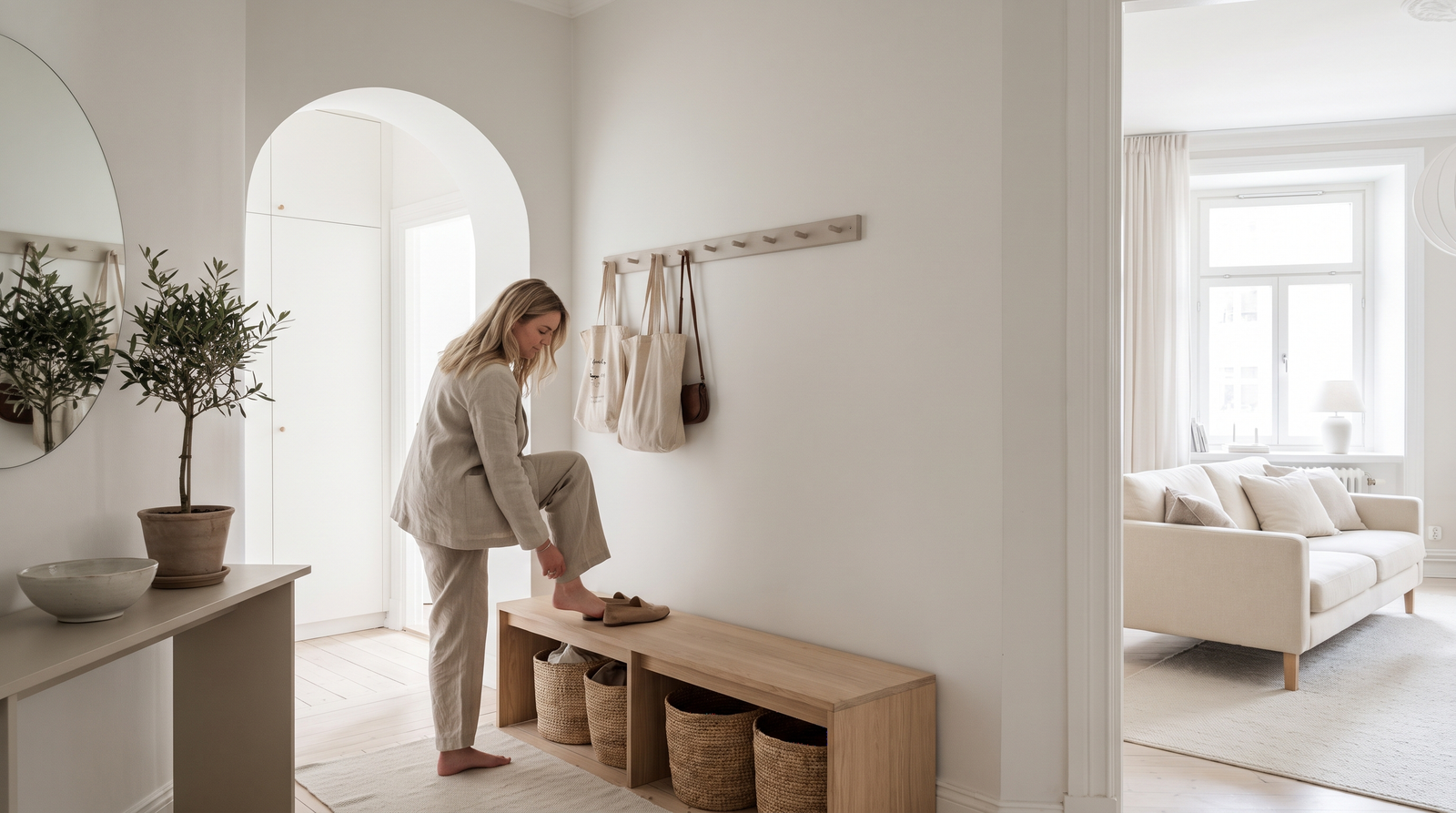
Turn your entryway design into a calming transition zone with the 3-Zone Decompression System for keys, shoes, mail, bags, and everyday clutter.
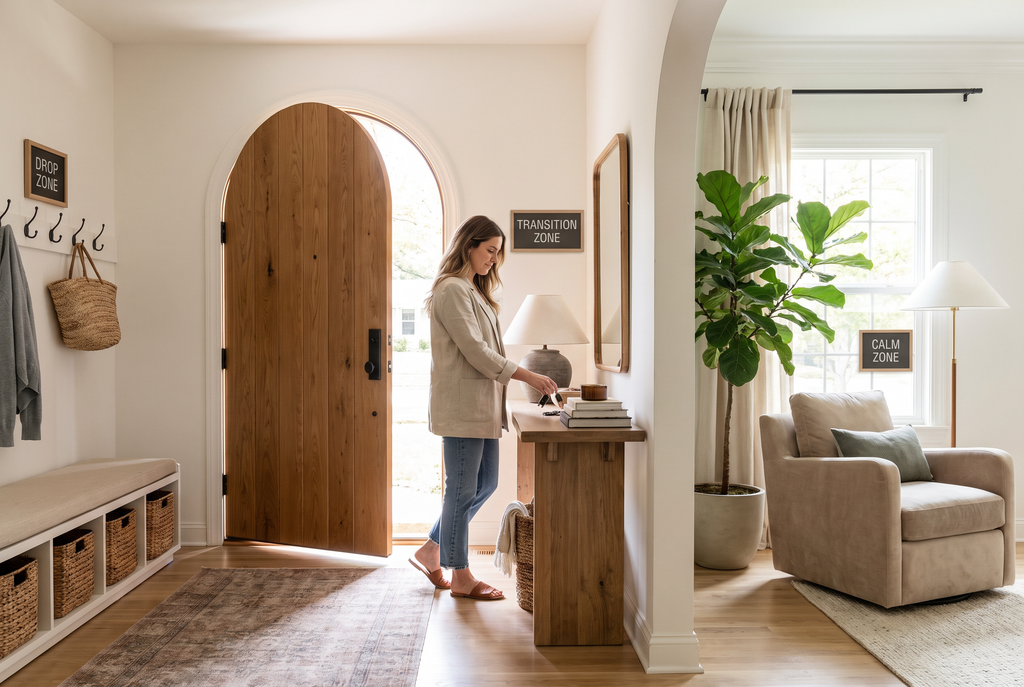
Your front door shouldn’t be the place where your workday follows you inside. You know that feeling.
You finally get home after a long day. You unlock the door, step inside, drop your bag—and immediately see everything you haven’t dealt with.
Keys on the console.
Shoes kicked halfway across the hallway.
A package you need to return.
Table of Contents
Three pieces of mail you haven’t opened. A tote bag you meant to take to work yesterday. Maybe a jacket hanging off a chair because there wasn’t anywhere else to put it. None of these things is particularly dramatic. But together?
They create a tiny visual emergency.
And that’s the problem with an entryway that has no system. It doesn’t simply collect objects. It collects unfinished decisions.
Your brain walks through the front door and immediately starts processing them.
Where do these keys go?
Should I open that envelope?
I need to return that package.
Why are my shoes there?
I have to remember that bag tomorrow.
Suddenly, you’re technically home—but mentally, you’re still working.
The solution isn’t necessarily a bigger entryway, more storage, or a minimalist renovation.
It’s a transition zone.
More specifically, a three-zone entryway designed to catch the chaos of the outside world before it spreads through your home.
Read more: The Routine: Scandi Lighting for the 3 PM Energy Crash Fix
Your Entryway Design Is a Psychological Border
Think about the entrance to your home differently.
It’s not just a place where you take off your coat.
It’s the border between two environments.
Outside is movement, noise, weather, errands, commuting, shopping, work, appointments, deliveries, and hundreds of tiny decisions.
Inside is where you want your nervous system to start winding down.
So why would you allow everything from outside to spill immediately into your living space?
Nordic homes have long treated the hall or entry area as a practical transition point. The goal isn’t to make the entrance look empty for an Instagram photograph.
It’s to make it work.
The best entryway doesn’t merely look tidy.
It tells every object where to go.
And when objects have somewhere to go, your brain has fewer decisions to make.
That’s where the three-zone system comes in.
Read more: The 15-Minute Nordic Sauna Reset: A Simple Home Heat Therapy Ritual
Zone 1: The Grip Drop — Your First Three Seconds
Let’s start with the moment your hand leaves the door handle.
You have approximately three seconds before you’re tempted to toss everything onto the nearest horizontal surface.
So give those things a designated landing spot.
Call it the Grip Drop.
This is where your everyday essentials go immediately.
Not eventually.
Not when you get around to tidying.
Immediately.
A small wall-mounted ledge or a heavy ceramic tray works beautifully because it creates a physical boundary around the habit.
The rules are intentionally strict:
Only daily essentials live here.
Think:
- House keys
- Car keys
- Phone
- Transit pass
- Access card
That’s it.
No receipts.
No sunglasses you haven’t worn in two weeks.
No unopened mail.
No loose change.
No mystery objects that somehow became permanent residents.
And especially:
Zero paper mail.
Mail is not an arrival item.
It’s an administrative task.
Those are different categories.
If you put mail next to your keys, your brain sees it every time you come home and receives another tiny reminder that something needs your attention.
That’s precisely what we’re trying to avoid.
A simple ceramic tray can make this remarkably easy. Look for something heavy enough that it won’t slide around when you toss your keys into it.
The goal isn’t decorative perfection.
It’s frictionless behavior.
You come in.
Keys down.
Phone down.
Done.
Why the Grip Drop Should Be Small
Here’s a counterintuitive trick:
Don’t make the landing area too large.
A huge console table invites accumulation.
A small ledge or compact tray creates scarcity.
If there’s physically only enough space for your essentials, the system enforces itself.
You don’t have to make a conscious decision every evening.
The environment makes the decision for you.
That’s good design.
You’re essentially removing a future choice before you have to make it.
And after a long workday, fewer choices are a gift.
Zone 2: The Air-Out Transition — Seconds 3 to 10
Now we get to the shoes.
Take them off.
Immediately.
Not because your home needs to resemble a laboratory, but because shoes are one of the easiest ways to physically transport the outside world indoors.
They collect dirt, moisture, and whatever you’ve stepped through during the day.
There’s also a psychological benefit to removing them.
It’s a tiny ritual.
Shoes off means the outside day is ending.
But here’s where many entryways go wrong.
People take off their shoes and then leave them in a pile.
Congratulations.
You’ve technically removed the shoes but created a new source of visual clutter.
The solution is concealed vertical storage.
The Vertical Shoe Cabinet Trick
If floor space is limited, think upward.
A slim-profile vertical shoe cabinet can hide footwear while keeping the floor visually clear.
This matters more than you might think.
An entryway with shoes scattered across the floor immediately feels busier.
A clear floor creates visual breathing room.
Look for a cabinet that’s:
- Narrow enough for your hallway
- Tall enough to use vertical space
- Fully enclosed
- Ventilated where appropriate
- Easy to access every day
The purpose isn’t to store every pair of shoes you own.
Seasonal and occasional footwear can live elsewhere.
The entryway should hold the shoes you actually rotate through.
That distinction keeps the system from becoming another storage problem.
And if you’re shopping for one, prioritize dimensions before aesthetics. Measure your available wall depth and door clearance first. A beautiful shoe cabinet that blocks the hallway is not a solution.
Zone 3: Closed Containment — Seconds 10 to 30
Now we arrive at the category that causes the most chaos:
Things that aren’t supposed to stay here—but aren’t ready to leave either.
A package needs returning.
A library book needs to go back.
Dry cleaning needs to be collected.
A laptop bag needs to go to work tomorrow.
There’s a gift you need to deliver.
These aren’t permanent household objects.
They’re transit items.
And transit items need their own container.
Enter Zone 3.
The One-Basket Rule
Choose one opaque woven basket or closed entryway cabinet for anything that’s temporarily in limbo.
One.
Not four.
Not a collection of beautifully labeled baskets that somehow become permanent storage.
One.
The basket acts like a waiting room.
Things can stay there temporarily because they’re going somewhere else.
But there’s an important rule:
If it doesn’t fit, it cannot stay in the entryway.
This is the part that makes the system work.
Without a capacity limit, containment simply becomes another form of clutter.
A giant basket that can hold six months of unfinished errands isn’t organization.
It’s procrastination with a lid.
Choose a container that’s large enough for your normal weekly flow but small enough to fill quickly.
Then empty it regularly.
Why Closed Storage Matters
You might be wondering why the basket should be opaque.
Because visual information is still information.
A transparent container lets your eyes scan every object inside it.
A closed container says:
Not your problem right now.
That’s surprisingly powerful.
You don’t need to see the package you’re returning every time you walk past it.
You need to know where it is.
There’s a difference.
Closed storage creates a visual boundary between your home and the tasks waiting outside it.
What About Mail?
Mail deserves its own rule because it has a nasty habit of multiplying.
Don’t let it enter the decompression zone.
When you walk inside, immediately separate it from your daily essentials.
Have a designated mail-processing location somewhere else—ideally near wherever you handle paperwork.
Then sort it.
Recycle junk mail.
File important documents.
Deal with anything requiring action.
The entryway shouldn’t become an inbox.
Your front door is a transition point, not your office.
The 30-Second Reset
The beauty of the three-zone system is that it doesn’t require a Saturday afternoon organizing marathon.
The whole process can take less than 30 seconds.
You walk in.
0–3 seconds: Keys and phone go into the Grip Drop.
3–10 seconds: Shoes come off and disappear into the shoe cabinet.
10–30 seconds: Transit items go into the closed basket.
Then you’re done.
No sorting.
No decision-making.
No staring at a pile and wondering where to begin.
The system handles the first part for you.
The Real Goal Isn’t a Perfect Entryway
Let’s be honest.
Your entryway will get messy sometimes.
Someone will drop a bag on the floor.
A delivery will arrive.
You’ll come home carrying groceries and forget the entire system exists.
That’s normal.
The goal isn’t perfection.
The goal is rapid recovery.
When every category has a designated home, resetting the space becomes easy.
You don’t have to ask where things belong.
You already decided.
That’s the difference between an organized home and a home that merely looks organized when you’ve just cleaned it.
Make the System Match Your Real Life
There’s one more rule worth remembering:
Design for your actual behavior, not your fantasy behavior.
If you always carry a work tote, make room for it.
If you bike to work, account for your helmet.
If you have children, the system needs to accommodate their shoes and bags.
If you live in a rainy climate, your entryway needs somewhere for wet outerwear.
If you frequently order packages, create a deliberate place for returns.
A beautiful system that requires you to behave like someone else will fail.
The best organizing systems are almost boring because they’re so obvious.
You walk in.
You know what to do.
The Entryway Reset Checklist
Before you finish setting up your three zones, check:
Zone 1 — Grip Drop
Can you reach it immediately after opening the door?
Does it have room only for daily essentials?
Is mail completely excluded?
Zone 2 — Air-Out Transition
Can shoes disappear from view?
Is the floor mostly clear?
Does the storage fit your everyday footwear rather than your entire collection?
Zone 3 — Closed Containment
Is there exactly one designated transit container?
Is it opaque?
Does it have a realistic capacity limit?
Can you empty it regularly?
If you can answer yes to those questions, you’ve already removed much of the friction from coming home.
Your Home Should Let You Exhale
We spend a lot of time trying to make our homes beautiful.
We choose paint colors.
We rearrange furniture.
We buy candles.
We obsess over lighting.
And all of those things matter.
But sometimes the most calming design decision isn’t decorative at all.
It’s deciding that your keys have one home.
Your shoes have one home.
Your unfinished errands have one home.
And none of them gets to spill beyond the front door.
Because your entryway is more than the first room people see.
It’s the first opportunity your home has to tell your brain: You’re off the clock now.
So build it accordingly.
A small ledge.
A hidden shoe cabinet.
One closed basket.
Thirty seconds.
That’s all it takes to create a boundary between the chaos you carried home and the calm you actually came home for.
And perhaps that’s the real Nordic lesson:
Don’t organize everything. Design the transition.
Once the transition works, the rest of your home gets a whole lot easier to breathe in.

One thought on “The Nordic 3-Zone Decompression Entryway Design: How to Stop Home Anxiety at the Front Door”