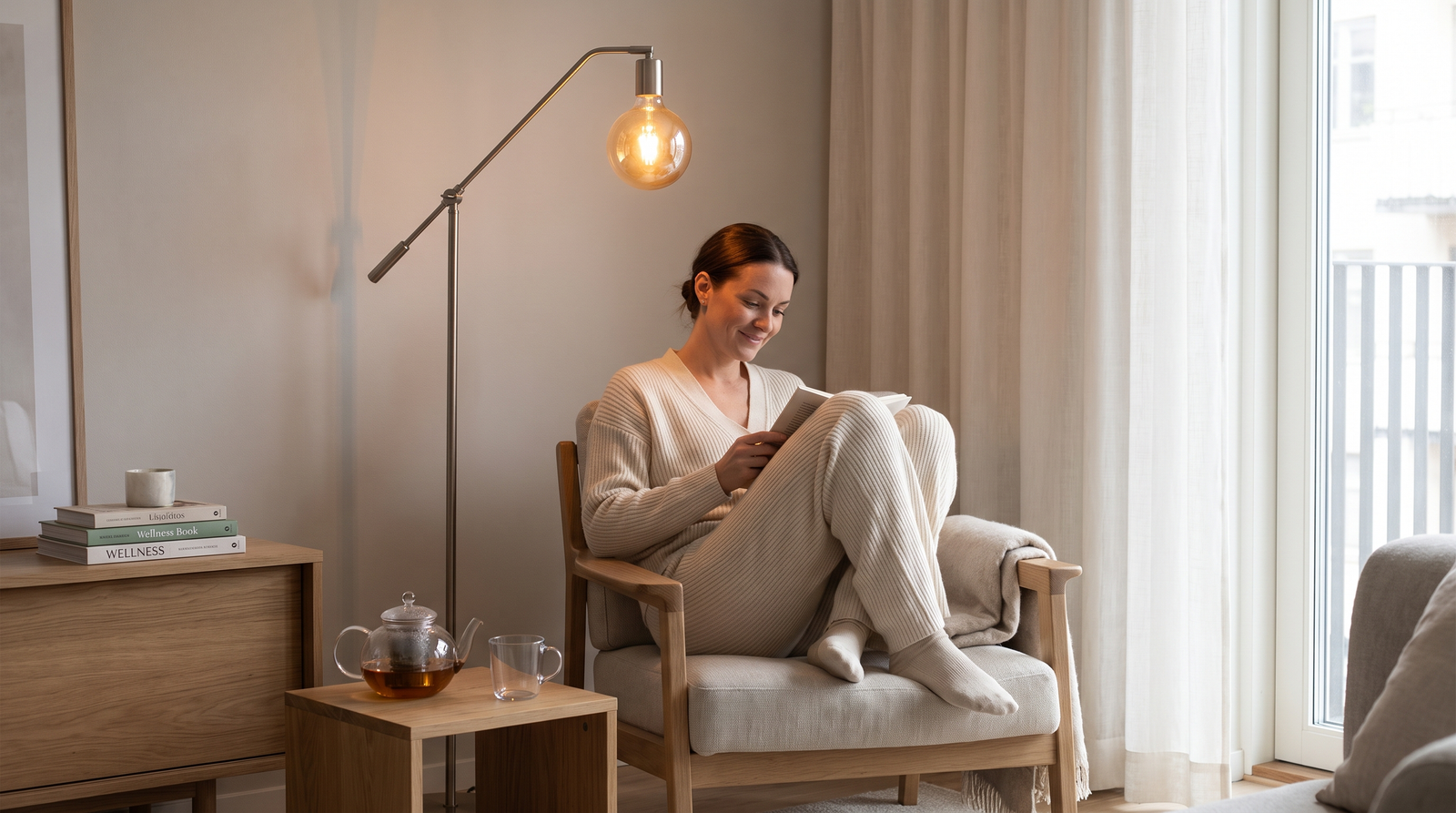
Feeling exhausted at 3 PM? Learn how strategic morning light, warmer evening lighting, and layered lamps can support your circadian rhythm and create an energy crash fix.
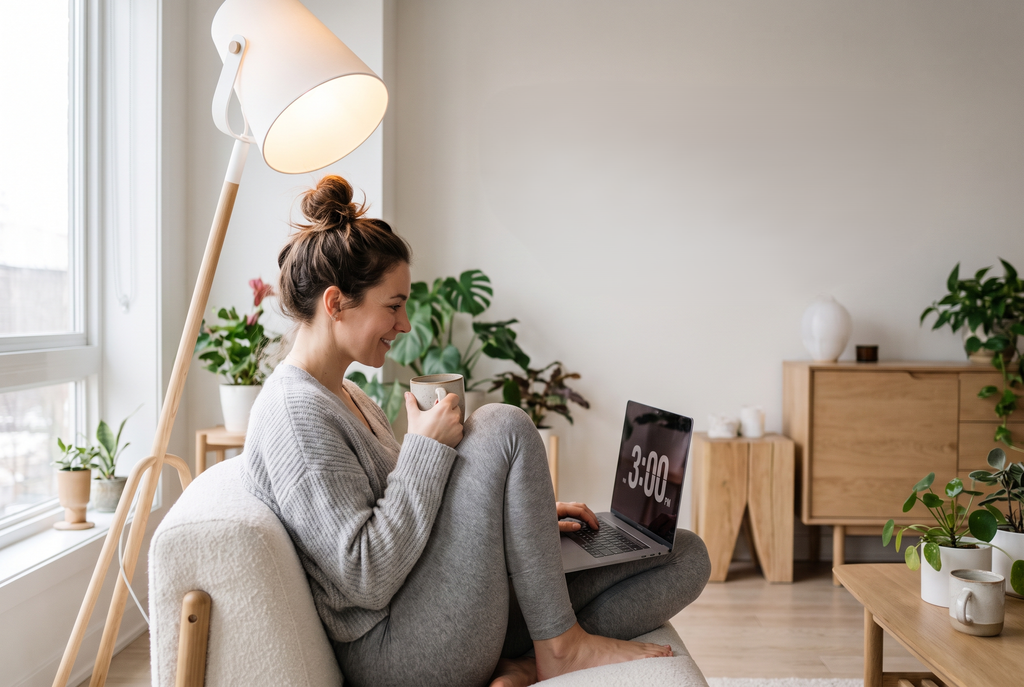
Your 3 PM crash might not need another coffee—it might need you to rethink the light you’re living under. Your brain feels foggy. Your eyes are tired. Your motivation has quietly left the building.
So you reach for another coffee.
Maybe something sweet.
Maybe your phone.
Maybe all three.
But before blaming yourself for having “no discipline” in the afternoon, look around.
Table of Contents
What kind of light are you sitting in?
If you’ve spent the day under dim indoor lighting, harsh overhead fluorescents, or a computer screen while the room around you stays dark, your environment may be working against your natural sleep-wake rhythm.
Light isn’t merely decoration.
It’s one of the strongest environmental signals influencing your circadian system—the internal timing system that helps coordinate sleep, wakefulness, alertness, and other biological processes.
And this is where Nordic-inspired lighting gets interesting.
In places where winter daylight can be dramatically limited, people have had to become unusually thoughtful about how they use artificial and natural light.
The Scandinavian lesson isn’t simply “buy prettier lamps.”
It’s:
Use light intentionally throughout the day.
Morning light should feel energizing.
Afternoon light should gradually soften.
Evening light should stop shouting.
And your home shouldn’t be illuminated like a supermarket at 10 p.m.
Light Is a Signal, Not Just a Decoration
Your eyes don’t simply use light so you can see your furniture.
Light also provides information to the brain about the time of day.
Morning light helps signal that it’s time to be awake and alert.
As evening approaches, decreasing light exposure helps your body transition toward nighttime.
This relationship is connected to hormones such as melatonin and cortisol, but it’s worth avoiding the simplistic idea that one lamp can magically “reset” your hormones.
Your circadian rhythm is influenced by many factors, including light timing and intensity, sleep schedule, activity, and individual biology.
Still, light timing matters.
And that gives us a surprisingly practical routine.
Think of your day as three lighting chapters:
Morning: Load up on light.
Afternoon: Start diffusing it.
Evening: Let the room become quieter.
That’s the Lux-Loading Routine.
The Morning Lux Flush
The first lighting decision of the day shouldn’t be made by your ceiling fixture.
It should ideally be made by the sun.
If you wake up and immediately spend the next hour in a dim bedroom, you’re giving your body relatively little environmental information that morning has begun.
Instead, get bright light exposure soon after waking.
Open the curtains.
Step outside.
Walk around the block.
Eat breakfast beside a bright window.
Have your coffee on a balcony or patio if weather permits.
Even better, combine light with movement.
You don’t need to turn your morning into a wellness ceremony involving seventeen supplements and a sunrise meditation playlist.
Just get into the light.
What If It’s Dark Outside?
That’s where a properly designed light-therapy device can be useful for some people.
A common standard for bright-light therapy is a device rated around 10,000 lux, typically used at a specified distance and for a prescribed duration according to the manufacturer’s instructions.
One recognizable option is the Carex Day-Light Classic Plus, a dedicated bright-light therapy lamp designed for light therapy rather than ordinary room illumination.
You can check the Carex Day-Light Classic Plus on Amazon to see the current product and specifications.
Don’t treat a therapy lamp like a regular desk lamp.
Read the manufacturer’s instructions for distance and duration, and don’t stare directly into the light.
And if you have an eye condition, take photosensitizing medication, or have a condition such as bipolar disorder, talk with a qualified healthcare professional before using bright-light therapy.
The goal isn’t to blast your eyeballs with light.
It’s to give your circadian system a strong, appropriately timed morning cue.
Your Window Is Free—and Surprisingly Powerful
Before buying anything, try the obvious option.
Use daylight.
Sit near a bright window for part of your morning.
If you can safely walk outdoors, even better.
The actual light level outdoors can be substantially higher than typical indoor lighting, even when the sky looks gray.
That’s one reason a short outdoor walk can be more than a mood booster.
It’s also a simple way to expose your eyes to a brighter natural environment.
Your morning routine might become:
Wake up.
Open curtains.
Drink coffee beside the window.
Go outside for a short walk.
Then start work.
That’s your first light intervention, and it costs nothing.
The 4 PM Diffusion Shift
Now let’s move to the opposite end of the day.
This is where many homes get lighting completely backward.
You come home.
The sun is fading.
You turn on every overhead fixture in the room.
Suddenly your living room is brighter than your office was at noon.
It looks efficient.
It doesn’t necessarily feel relaxing.
As evening approaches, consider gradually reducing your exposure to bright overhead lighting, particularly if you find intense light late in the evening disruptive to your sleep.
The goal isn’t to sit in darkness at 4 p.m.
It’s to create a transition.
Instead of one enormous ceiling light doing all the work, start using smaller pools of illumination.
Think floor lamp.
Table lamp.
Wall light.
Reading lamp.
Kitchen under-cabinet lighting.
The room becomes softer without becoming impractical.
Why Eye-Level Light Feels Different
There’s something psychologically calming about a room illuminated from several smaller sources.
Compare these two scenes.
Scene A
One bright ceiling fixture.
Every surface is equally illuminated.
There are strong shadows.
The room feels functional.
Scene B
A warm table lamp beside the sofa.
A floor lamp in the corner.
A small light near a bookshelf.
The kitchen counter has subtle under-cabinet illumination.
The ceiling light is off.
Suddenly the room has depth.
Your eye moves through it.
Not everything is demanding attention at once.
That’s the Island Lighting Method.
Chapter Three: Create Islands of Light
Forget trying to illuminate every square inch equally.
Instead, create three to five small islands of light around the room.
You might have:
Island 1: A table lamp beside the sofa.
Island 2: A floor lamp near a reading chair.
Island 3: A small lamp on a sideboard.
Island 4: A subtle light near a bookshelf or artwork.
Island 5: Practical kitchen lighting where you actually need it.
You don’t have to use all five.
The principle is simply to distribute warm, lower-intensity light rather than relying on one aggressive overhead source.
This approach is also wonderfully forgiving.
Your lamps don’t need to match.
In fact, they can be completely different.
A ceramic lamp beside a linen sofa.
A sculptural floor lamp near a wooden chair.
A tiny portable lamp on a bookshelf.
What connects them is the quality and placement of the light, not necessarily the furniture-store catalog.
Choose the Bulb Before You Choose the Lamp
Here’s a mistake worth avoiding.
People spend hours shopping for beautiful lamps and approximately twelve seconds thinking about the bulb.
The bulb matters.
For evening spaces, many people prefer warm color temperatures around 2700K or lower because they produce a warmer, more amber-toned appearance.
That doesn’t mean every room should use exactly 2700K.
A kitchen workspace, bathroom, or home office may benefit from different lighting depending on the task.
But your evening relaxation zones can generally afford to be warmer and softer.
Look for bulbs that clearly state their color temperature.
And don’t assume “warm white” means the same thing across every manufacturer.
Check the Kelvin rating.
Lower Kelvin = warmer-looking light.
The Product That Makes This Easy
If you want to experiment without replacing your entire lighting system, a simple smart bulb can be an excellent starting point.
The Philips Hue White Ambiance A19 is designed to provide adjustable white-light temperatures, allowing you to shift between cooler and warmer tones throughout the day.
You can shop the Philips Hue White Ambiance A19 on Amazon and check current availability, bulb compatibility, and pricing.
The appeal isn’t that you need a smart bulb.
You don’t.
A normal warm bulb works perfectly well.
The advantage is convenience: you can schedule or adjust the color temperature rather than manually swapping bulbs or remembering to change settings.
That makes the habit easier to maintain.
And good habits tend to survive when they’re convenient.
The 3 PM Rescue Isn’t Another Espresso
Let’s come back to that afternoon crash.
If you’re sitting indoors all day, don’t wait until 3 p.m. to discover you’re exhausted.
Build light into your schedule earlier.
Try this:
Morning: Get bright natural light soon after waking.
Midday: Step outside for a walk or spend time in a brighter environment.
Early afternoon: Keep your workspace appropriately bright for the task.
Late afternoon: If you’re transitioning toward home and evening, begin reducing unnecessarily harsh overhead lighting.
Evening: Use warm, localized lamps rather than bathing the entire house in bright ceiling light.
This isn’t a magic productivity hack.
It won’t cure chronic fatigue.
If you’re persistently exhausted despite adequate sleep, it’s worth discussing that with a healthcare professional rather than assuming your lamps are the problem.
But your lighting environment is one variable you can actually control.
The Scandinavian Secret Isn’t Darkness
When people think of Scandinavian interiors, they often imagine candles, pale walls, wool blankets, and tiny lamps glowing in dark rooms.
That’s part of the aesthetic.
But there’s a deeper principle underneath it:
Light is designed around human experience.
A Scandinavian-inspired room doesn’t necessarily try to make every moment look like noon.
It recognizes that morning, afternoon, and evening have different emotional and functional needs.
That’s what makes layered lighting feel so good.
The room changes with you.
Don’t Turn Your Home Into a Cave
There’s an important distinction here.
Warm evening lighting doesn’t mean your home should become dim and gloomy.
You still need adequate illumination to cook safely, read comfortably, clean, work, and move around without tripping over the coffee table.
Use brighter task lighting where necessary.
Then keep ambient lighting softer.
Think layers, not darkness.
Task light for what you’re doing.
Ambient light for the room.
Accent light for atmosphere.
That’s how you get both function and calm.
A Simple Lux-Loading Schedule
If you want to try the system without buying anything, start here.
Morning
Open every curtain you can.
Sit near daylight while you have breakfast.
Get outside if possible.
Workday
Don’t work in a dark room with only your monitor glowing.
Keep your workspace appropriately illuminated.
Take a daylight break.
Late Afternoon
Turn off unnecessary overhead lights as natural daylight fades.
Switch to lamps where practical.
Evening
Use warm-spectrum bulbs.
Create three or more small lighting islands.
Keep the brightest light reserved for tasks that actually require it.
Before Bed
Gradually reduce unnecessary brightness and keep the environment comfortable for winding down.
Your bedroom doesn’t need to look like an airport terminal at midnight.
The Bigger Idea
Your home doesn’t need more lighting.
It needs better timing.
That’s the real shift.
Instead of asking:
“Is this room bright enough?”
start asking:
“Is this the right kind of light for this time of day?”
At 8 a.m., you want energy.
At 4 p.m., you want transition.
At 9 p.m., you want calm.
Those aren’t contradictory goals.
They’re different chapters of the same day.
And once you stop expecting one ceiling fixture to handle all three, your home starts to feel dramatically more sophisticated.
Your Evening Lighting Reset
Tonight, try one experiment.
Turn off the overhead light.
Put a warm lamp beside the sofa.
Add another small lamp somewhere across the room.
Leave the brightest practical light on only where you’re actually doing something.
Then sit down.
Notice the shadows.
Notice how your eyes move around the room.
Notice whether the space feels less like an office and more like somewhere you can actually exhale.
You may discover that the problem wasn’t that your home needed more light.
It was that every room had been shouting at you at the same volume.
The Nordic-inspired solution is quieter.
Bright when your body needs a morning signal.
Layered when the day winds down.
Warm when it’s time to come home.
And soft enough, eventually, to let the night be night.
That 3 PM crash may not disappear because of a lamp.
But by treating light as part of your daily rhythm instead of an afterthought, you can create an environment that works with your body rather than constantly asking it to adapt.
And honestly?
After a long day, your home shouldn’t feel like another workplace.
It should know when to turn the volume down.


2 thoughts on “The Lux-Loading Routine: Nordic Lighting for the 3 PM Energy Crash Fix”